
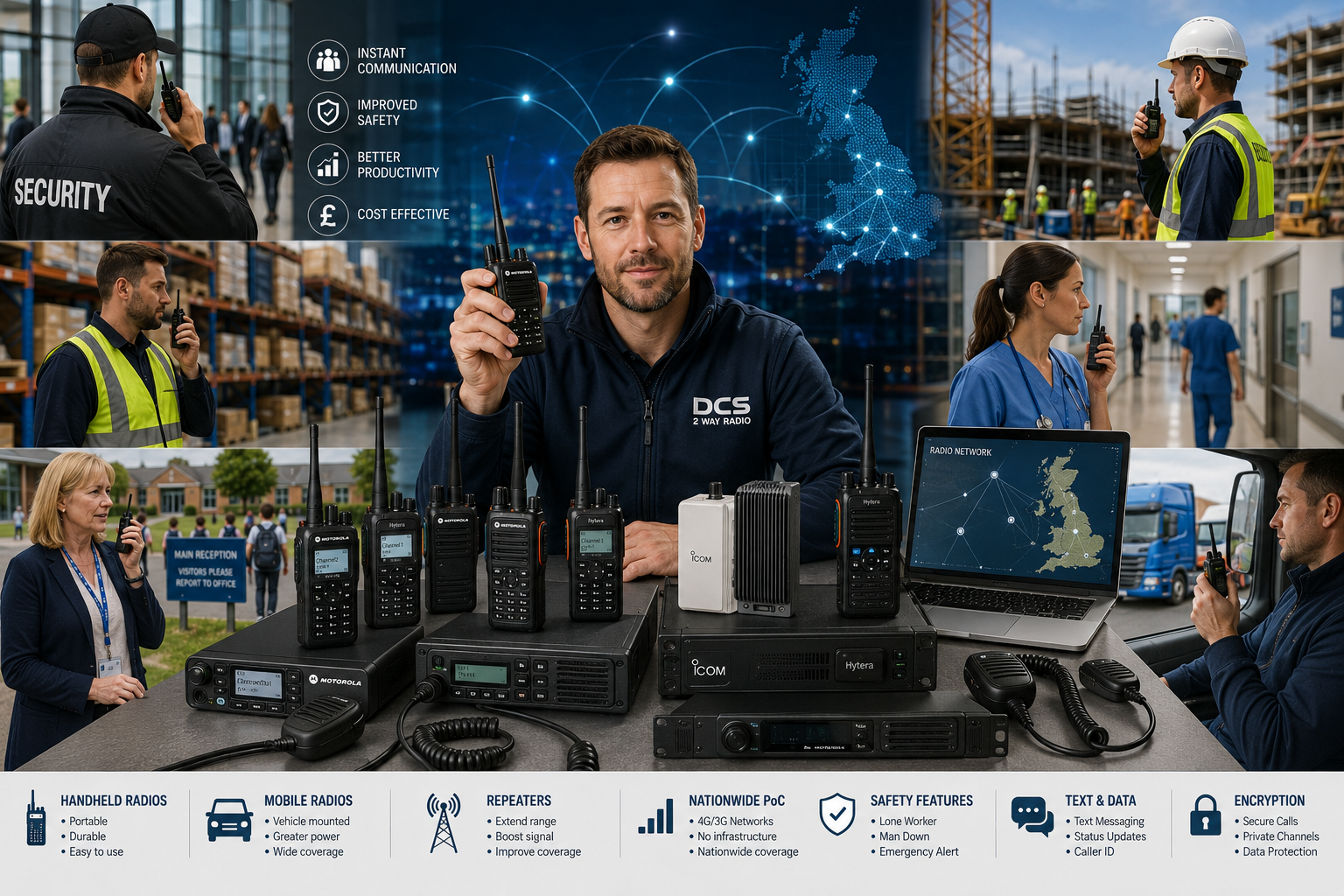
Everything You Need to Know About Business Radio Communications
Effective communication is at the heart of every successful organisation. Whether you're managing a construction site, operating a warehouse, coordinating security teams or running a major event, the ability to communicate instantly can have a significant impact on productivity, safety and customer service.
Two-way radios continue to be one of the most dependable and efficient communication tools available to businesses. Modern digital radio systems offer exceptional audio quality, advanced safety features and flexible communication options that often outperform mobile phones in demanding working environments.
This guide explains how two-way radios work, the different types available and how they can benefit your organisation.
What Is a Two-Way Radio?
A two-way radio is a communication device capable of both transmitting and receiving voice messages.
Unlike a mobile phone, which requires a call to be dialled and answered, a two-way radio allows instant communication at the press of a button.
Users can communicate:
- One-to-one
- One-to-many
- Department-to-department
- Site-wide
- Across multiple locations
This ability to communicate instantly makes two-way radios particularly valuable in busy operational environments.
How Two-Way Radios Benefit Businesses
Modern radio systems provide a wide range of operational advantages.
Improved Productivity
Employees can communicate instantly without making phone calls or sending messages, reducing delays and enabling quicker decision-making.
Enhanced Health and Safety
Emergency features such as Lone Worker, Man Down and Emergency Alerts help organisations protect staff working alone or in potentially hazardous environments.
Better Customer Service
Faster communication between departments allows businesses to respond more quickly to customer requests and resolve issues efficiently.
Greater Operational Efficiency
Teams remain connected at all times, helping businesses coordinate resources and respond rapidly to changing situations.
Industries That Use Two-Way Radios
Virtually every industry can benefit from professional radio communications.
Some of the sectors we regularly support include:
- Security
- Construction
- Manufacturing
- Warehousing and logistics
- Transport and distribution
- Healthcare
- Education
- Local authorities
- Retail
- Hospitality
- Event management
- Sports stadiums
- Recycling and waste management
Modern radios are simple to use and require very little training, making them suitable for users at every level of an organisation.
Types of Two-Way Radio Equipment
Choosing the right type of radio equipment depends on your working environment and communication requirements.
Digital Handheld Radios
Often referred to as walkie-talkies, handheld radios are the most common type of two-way radio.
Benefits include:
- Portable and lightweight
- Instant communication
- Long battery life
- Rugged construction
- Easy operation
These radios are ideal for staff working on foot across sites, buildings and events.
Digital Mobile Radios
Mobile radios are permanently installed within vehicles and use the vehicle's electrical system for power.
They are commonly used by:
- Transport operators
- Delivery fleets
- Utility companies
- Security patrol vehicles
- Taxi operators
Mobile radios generally offer greater power output and coverage than handheld devices.
Digital Repeaters
A repeater receives and retransmits radio signals, significantly extending communication range.
Repeaters are often used:
- Across large sites
- In warehouses
- In hospitals
- Across towns and cities
- On wide-area radio networks
They help maintain clear communications where distance or obstacles would otherwise weaken radio signals.
Key Features of Modern Two-Way Radios
Today's digital radio systems offer far more than simple voice communication.
Emergency Alert
A dedicated emergency button allows users to instantly request assistance during an emergency.
Lone Worker Protection
Staff working alone are prompted to check in periodically. Failure to respond triggers an alert.
Man Down Functionality
The radio can detect unusual movement or lack of movement and automatically raise an alarm if a user may be injured.
Text Messaging
Many digital radios support text messaging, allowing information such as addresses, reference numbers and instructions to be transmitted discreetly.
Caller Identification
Display-equipped radios can identify the user transmitting a message, making communications easier to manage.
Digital Encryption
Encryption prevents unauthorised users from listening to your conversations, providing a secure communication platform.
Our Two-Way Radio Services
At DCS 2 Way Radio, we provide a complete range of communication solutions tailored to the needs of modern organisations.
Two-Way Radio Hire
Hiring radios can be a highly cost-effective alternative to purchasing equipment outright.
Benefits include:
- Low upfront costs
- Flexible hire periods
- Access to modern equipment
- Maintenance included
- Technical support
- Licensing included where appropriate
We offer both short-term and long-term hire packages.
On-Site Radio Systems
An on-site radio system is ideal for organisations operating within:
- Factories
- Warehouses
- Hospitals
- Schools
- Hotels
- Shopping centres
- Industrial estates
These systems provide reliable communication across a defined location or campus.
Wide Area Digital Radio Networks
For organisations operating across multiple sites or larger geographical areas, wide area radio networks provide extended coverage using linked repeater infrastructure.
These systems support:
- Handheld radios
- Vehicle-mounted radios
- Control room operations
- Large-scale business communications
Radio Equipment Leasing
Leasing allows organisations to spread the cost of new communication equipment over manageable monthly or quarterly payments.
Benefits include:
- Preserved cash flow
- Access to the latest technology
- Flexible finance terms
- Predictable budgeting
Lease options are available over two to five years.
Nationwide Coverage with Icom PoC Radios
Push-to-Talk Over Cellular (PoC) technology combines the simplicity of two-way radios with the coverage of nationwide 4G and LTE networks.
Benefits include:
- Nationwide communication
- No repeaters required
- Licence-free operation
- GPS location services
- Secure communications
- Excellent voice quality
This solution is ideal for businesses operating across multiple locations throughout the UK.
Which Solution Is Right for You?
Every organisation has different communication requirements.
The ideal solution will depend on factors such as:
- Number of users
- Site size
- Coverage requirements
- Industry sector
- Safety considerations
- Budget
Our experienced team can help assess your requirements and recommend the most effective communication system for your business.
Speak to the Experts
Whether you're exploring radio communications for the first time or upgrading an existing system, DCS 2 Way Radio can help.
Call 0800 294 7766 today for expert advice and a free consultation on the best two-way radio solution for your organisation.Your Complete Guide to Two-Way Radios
Everything You Need to Know About Business Radio Communications
Effective communication is at the heart of every successful organisation. Whether you're managing a construction site, operating a warehouse, coordinating security teams or running a major event, the ability to communicate instantly can have a significant impact on productivity, safety and customer service.
Two-way radios continue to be one of the most dependable and efficient communication tools available to businesses. Modern digital radio systems offer exceptional audio quality, advanced safety features and flexible communication options that often outperform mobile phones in demanding working environments.
This guide explains how two-way radios work, the different types available and how they can benefit your organisation.
What Is a Two-Way Radio?
A two-way radio is a communication device capable of both transmitting and receiving voice messages.
Unlike a mobile phone, which requires a call to be dialled and answered, a two-way radio allows instant communication at the press of a button.
Users can communicate:
- One-to-one
- One-to-many
- Department-to-department
- Site-wide
- Across multiple locations
This ability to communicate instantly makes two-way radios particularly valuable in busy operational environments.
How Two-Way Radios Benefit Businesses
Modern radio systems provide a wide range of operational advantages.
Improved Productivity
Employees can communicate instantly without making phone calls or sending messages, reducing delays and enabling quicker decision-making.
Enhanced Health and Safety
Emergency features such as Lone Worker, Man Down and Emergency Alerts help organisations protect staff working alone or in potentially hazardous environments.
Better Customer Service
Faster communication between departments allows businesses to respond more quickly to customer requests and resolve issues efficiently.
Greater Operational Efficiency
Teams remain connected at all times, helping businesses coordinate resources and respond rapidly to changing situations.
Industries That Use Two-Way Radios
Virtually every industry can benefit from professional radio communications.
Some of the sectors we regularly support include:
- Security
- Construction
- Manufacturing
- Warehousing and logistics
- Transport and distribution
- Healthcare
- Education
- Local authorities
- Retail
- Hospitality
- Event management
- Sports stadiums
- Recycling and waste management
Modern radios are simple to use and require very little training, making them suitable for users at every level of an organisation.
Types of Two-Way Radio Equipment
Choosing the right type of radio equipment depends on your working environment and communication requirements.
Digital Handheld Radios
Often referred to as walkie-talkies, handheld radios are the most common type of two-way radio.
Benefits include:
- Portable and lightweight
- Instant communication
- Long battery life
- Rugged construction
- Easy operation
These radios are ideal for staff working on foot across sites, buildings and events.
Digital Mobile Radios
Mobile radios are permanently installed within vehicles and use the vehicle's electrical system for power.
They are commonly used by:
- Transport operators
- Delivery fleets
- Utility companies
- Security patrol vehicles
- Taxi operators
Mobile radios generally offer greater power output and coverage than handheld devices.
Digital Repeaters
A repeater receives and retransmits radio signals, significantly extending communication range.
Repeaters are often used:
- Across large sites
- In warehouses
- In hospitals
- Across towns and cities
- On wide-area radio networks
They help maintain clear communications where distance or obstacles would otherwise weaken radio signals.
Key Features of Modern Two-Way Radios
Today's digital radio systems offer far more than simple voice communication.
Emergency Alert
A dedicated emergency button allows users to instantly request assistance during an emergency.
Lone Worker Protection
Staff working alone are prompted to check in periodically. Failure to respond triggers an alert.
Man Down Functionality
The radio can detect unusual movement or lack of movement and automatically raise an alarm if a user may be injured.
Text Messaging
Many digital radios support text messaging, allowing information such as addresses, reference numbers and instructions to be transmitted discreetly.
Caller Identification
Display-equipped radios can identify the user transmitting a message, making communications easier to manage.
Digital Encryption
Encryption prevents unauthorised users from listening to your conversations, providing a secure communication platform.
Our Two-Way Radio Services
At DCS 2 Way Radio, we provide a complete range of communication solutions tailored to the needs of modern organisations.
Two-Way Radio Hire
Hiring radios can be a highly cost-effective alternative to purchasing equipment outright.
Benefits include:
- Low upfront costs
- Flexible hire periods
- Access to modern equipment
- Maintenance included
- Technical support
- Licensing included where appropriate
We offer both short-term and long-term hire packages.
On-Site Radio Systems
An on-site radio system is ideal for organisations operating within:
- Factories
- Warehouses
- Hospitals
- Schools
- Hotels
- Shopping centres
- Industrial estates
These systems provide reliable communication across a defined location or campus.
Wide Area Digital Radio Networks
For organisations operating across multiple sites or larger geographical areas, wide area radio networks provide extended coverage using linked repeater infrastructure.
These systems support:
- Handheld radios
- Vehicle-mounted radios
- Control room operations
- Large-scale business communications
Radio Equipment Leasing
Leasing allows organisations to spread the cost of new communication equipment over manageable monthly or quarterly payments.
Benefits include:
- Preserved cash flow
- Access to the latest technology
- Flexible finance terms
- Predictable budgeting
Lease options are available over two to five years.
Nationwide Coverage with Icom PoC Radios
Push-to-Talk Over Cellular (PoC) technology combines the simplicity of two-way radios with the coverage of nationwide 4G and LTE networks.
Benefits include:
- Nationwide communication
- No repeaters required
- Licence-free operation
- GPS location services
- Secure communications
- Excellent voice quality
This solution is ideal for businesses operating across multiple locations throughout the UK.
Which Solution Is Right for You?
Every organisation has different communication requirements.
The ideal solution will depend on factors such as:
- Number of users
- Site size
- Coverage requirements
- Industry sector
- Safety considerations
- Budget
Our experienced team can help assess your requirements and recommend the most effective communication system for your business.
Speak to the Experts
Whether you're exploring radio communications for the first time or upgrading an existing system, DCS 2 Way Radio can help.
Call 0800 294 7766 today for expert advice and a free consultation on the best two-way radio solution for your organisation.