
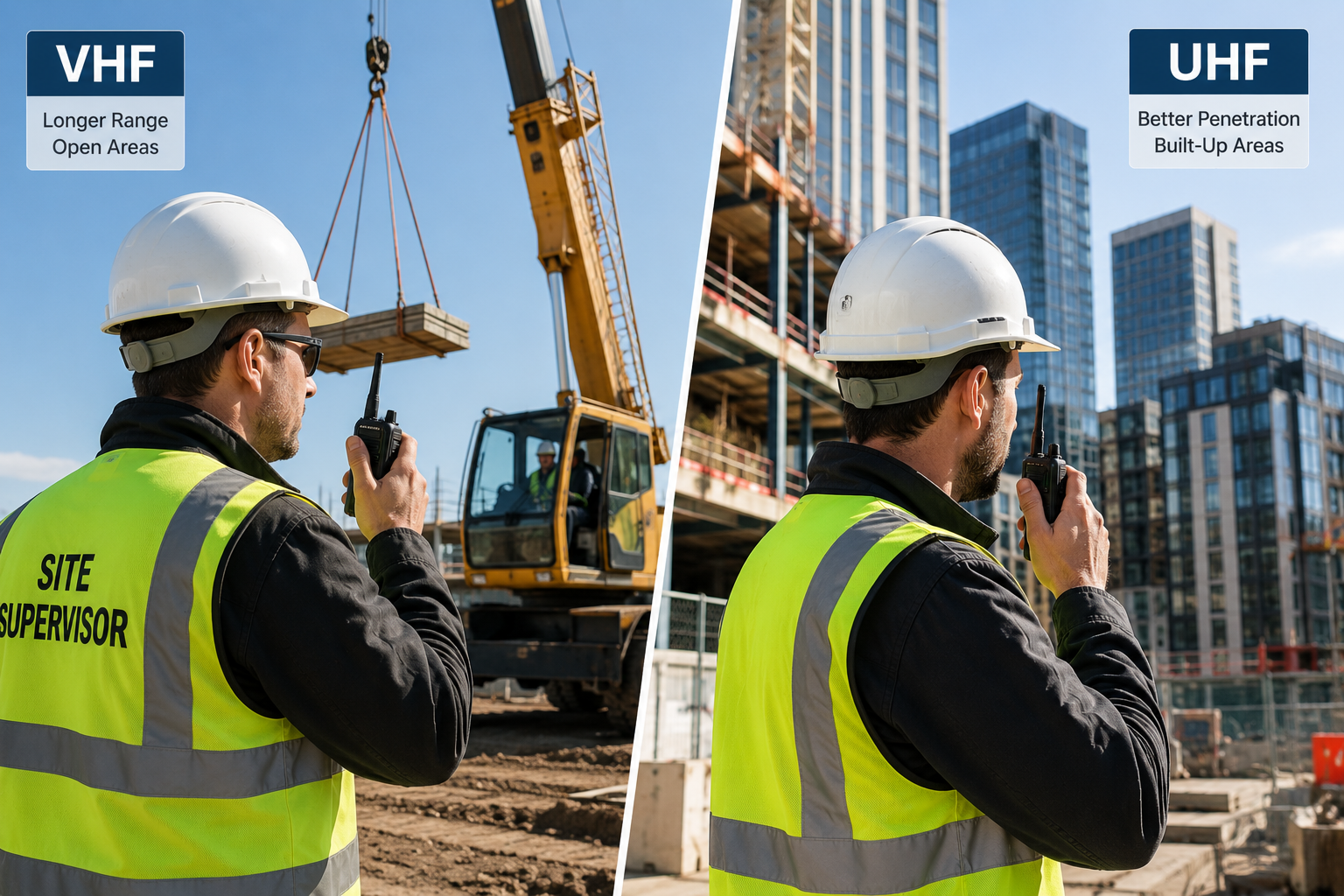
VHF vs UHF Two-Way Radios: Which Is Right for Your Business?
When selecting a two-way radio system, one of the most important decisions is whether to choose a VHF or UHF radio.
Both technologies provide reliable communication, but their performance can vary significantly depending on the environment in which they are used. Understanding the strengths of each frequency range will help ensure you get the best possible coverage and communication quality for your organisation.
Understanding the Difference
The primary difference between VHF and UHF radios lies in the frequency range they operate on.
- VHF (Very High Frequency) operates on lower frequencies.
- UHF (Ultra High Frequency) operates on higher frequencies.
These differences affect how radio signals travel and how well they perform in different environments.
UHF Radios
Best for Built-Up and Indoor Environments
UHF signals perform particularly well in areas containing obstacles such as buildings, walls, metal structures and dense vegetation.
Because UHF signals can more effectively penetrate and navigate around these obstacles, they are often the preferred choice for:
- Warehouses
- Schools and colleges
- Retail environments
- Shopping centres
- Hotels
- Indoor security operations
- Urban locations
In environments where communication needs to pass through walls, floors or other structures, UHF radios generally provide superior performance.
Compact and Convenient
Another advantage of UHF radios is their shorter antenna design.
The smaller antennas make radios easier to carry and more comfortable to wear, particularly for users such as security personnel, retail staff and event teams who carry radios throughout the day.
VHF Radios
Best for Open Outdoor Areas
VHF signals use longer wavelengths, allowing them to travel greater distances in open environments with fewer obstacles.
For organisations operating primarily outdoors, VHF radios can often provide excellent coverage without requiring additional infrastructure.
Typical applications include:
- Construction sites
- Farms and agricultural operations
- Grounds maintenance
- Golf courses
- Outdoor events
- Forestry operations
- Marine communications
- Aviation communications
Where clear line-of-sight communication is available, VHF can often achieve greater range than UHF.
Limitations Indoors
While VHF performs exceptionally well outdoors, it is generally less effective when signals need to pass through concrete, steel or other building materials.
For organisations operating mainly inside buildings or in heavily built-up urban environments, UHF is usually the better option.
Can You Convert a VHF Radio to UHF?
No.
VHF and UHF radios are built with different internal hardware designed specifically for their operating frequency ranges.
This means a VHF radio cannot be converted into a UHF radio, and vice versa.
If you are expanding an existing radio fleet, any additional radios will normally need to match the frequency band used by your current equipment.
Which Frequency Should You Choose?
As a general guide:
Choose UHF if you work in:
- Warehouses
- Factories
- Retail stores
- Schools
- Hotels
- Security environments
- Towns and cities
Choose VHF if you work in:
- Construction sites
- Farms
- Open countryside
- Sports grounds
- Parks and estates
- Outdoor events
- Marine environments
Expert Advice from DCS 2 Way Radio
Selecting the right frequency can have a significant impact on communication quality, coverage and reliability.
At DCS 2 Way Radio, we supply both VHF and UHF radio systems and can help you identify the most suitable solution based on your operating environment and communication requirements.
If you are unsure which option is right for your business, our experienced team is here to help.
Call 0800 294 7766 or contact us today for free expert advice.